
Edited by Sidney McAlear
Welcome in
New here? I’m John “Rain” Waters — The Lowdown is your intel brief on aviation, defense, and geopolitics. No noise. No spin. Just the stuff that matters. Subscribe and stick around…or don’t…the choice is yours.
Before anything else:
On Friday, U.S. Central Command confirmed what many of us feared. All six crew members aboard the KC-135 that went down during Operation Epic Fury have perished. A safety investigation is underway, followed by an accident investigation that will eventually be made public — though we won’t see those findings for quite some time.
Tanker crews don’t often make the highlight reel. They do their mission quietly. Without them, combat airpower grinds to a halt. We often take it for granted and consider them out of harm’s way — but what they do, day in and day out, is fraught with risk.
No One Kicks Ass Without Tanker Gas. #NKAWTG
To their families and friends receiving the worst news of their lives right now — our thoughts and prayers are with you.
Also on our minds: the families and friends of the other seven service members lost since the opening hours of Epic Fury.

Top of tail of the other KC-135 involved in the Thursday incident
Watch & Listen
Stories from the Cockpit & Beyond

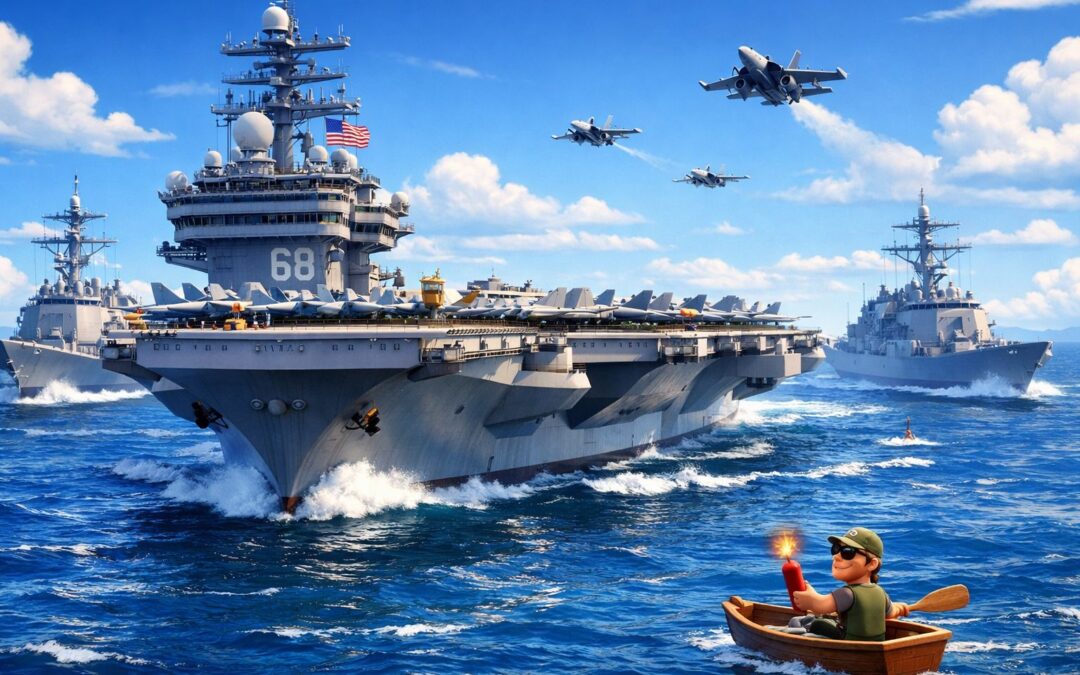
My take: The Strait is the real problem
Everyone is watching the strike count.
Here’s the challenge: nobody has a clean answer. The U.S. and Gulf partners have to provide 100% assurance that ships can transit the Persian Gulf and the Strait of Hormuz safely.
To use my baseball analogy: That means “batting a thousand”. Every single time. No misses.
Iran doesn’t need to bat a thousand. They don’t even need a hit. A foul ball wins. A single wins. A double definitely wins. And we’ve seen exactly that this week — multiple tankers struck and oil refinery facilities hit, not just in the Strait but in and around the broader Gulf. Crews floating in life rafts. Footage that rattles insurance underwriters and shipping executives in boardrooms from London to Singapore.
The U.S. and coalition forces have been remarkably effective at suppressing Iran’s conventional military. Air defenses are largely gone. The navy is largely gone. The missile launch rate is down over 90%. By any traditional measure, this is a one-sided fight.
But the Strait doesn’t care about traditional measures.
Iran doesn’t need a functional military to keep the Strait effectively closed. They need a drone here, a mine there, an unmanned surface vessel loaded with explosives on a one-way trip. The calculus is brutally asymmetric, and they know it.
How we get to a point where there is assured safety for ships to transit is the question. I don’t have a clean answer. I’m not sure anyone does right now.
The Army quietly made history. Not Many Noticed.
While everyone has been watching the air campaign, the Army has been sinking ships. ATACMS, the Army Tactical Missile System, has been used to destroy multiple Iranian naval vessels and at least one Iranian submarine. Let that sink in. Ground-launched ballistic missiles hitting naval targets. For the first time in history. The weapon fires from HIMARS (High Mobility Artillery Rocket System), carries nearly 4,000 lbs of ordnance (1,670 kg), reaches out to 190 nautical miles (300 km), and tops out at 160,000 feet.
The GBU-57 may have come out again
The 30,000 lb Massive Ordnance Penetrator (GBU-57/B), first used in Operation Midnight Hammer, appears to have been dropped again, this time on the Parchin military complex about 20-30 miles southeast of Tehran.
The IAEA has had this site on its radar for years, suspected of producing specialized explosives for nuclear weapon development. Iran reinforced and buried it deeper after previous Israeli strikes in 2024 and the 12 Day War. Didn’t matter. The B-2 carries two of these. CENTCOM hasn’t confirmed, but the blast footage and impact craters tell the story.
An Emirati F-16 shot down an Iranian drone three miles from Dubai International
The UAE’s Block 60 Desert Falcon — one of the most capable F-16 variants on the planet — intercepted a Shahed-style drone over Al Mansour Beach, low altitude, with civilians filming from the sand. The F-16 took the drone down with a missile shot as they flew toward the city.
Support the Afterburn Podcast
Unlock exclusive There I Was… stories & ad-free interviews
AI is running the kill chain
It has been reported that Anthropic’s Claude AI, embedded inside Palantir’s Maven Smart System, helped generate over 1,000 strike options, routes, and target priorities in the first 24 hours of Epic Fury. Human commanders review and authorize. But what used to require toggling between 8-9 different systems at different classification levels is now one screen. When you’re running 1,000+ strikes a day, that’s not a convenience. That’s a force multiplier.
Watch & Listen
Stories from the Cockpit & Beyond
