
Edited by Sidney McAlear

Welcome in
The Lowdown is your intel brief on aviation, defense, and geopolitics. No noise. No spin. Just the stuff that matters. Subscribe and stick around…or don’t…the choice is yours.
Check us out on Youtube: Afterburn Defense & Afterburn Podast
The scoreboard looks good. But how does the supply room look?
Everyone is watching the strike footage. Mushroom clouds over Parchin. Iranian air defenses largely gone. Missile launch rates down 90 percent. By any traditional measure, this is the definition of dominance. But what is the cost? To be fair, I don’t think we will know that answer…the true answer…for years.
5,197 munitions in 96 hours
The Foreign Policy Research Institute published an analysis this week that should be required reading for anyone following this war. In the first four days of Operation Epic Fury, the US-led coalition expended 5,197 munitions across 35 weapons types. FPRI calls it “the most munitions-intensive opening air campaign in modern history, dwarfing Libya 2011”, which used approximately 735 munitions in its first three days. We burned through seven times that in the same window.
The munitions-only replacement bill runs $10 to $16 billion. Add destroyed sensors and aircraft attrition and you’re sitting at roughly $20 billion. CSIS puts the first 100 hours alone at $3.7 billion, running at approximately $891 million per day. Penn Wharton’s Budget Model projects $40 to $95 billion for a two-month conflict, depending on whether boots hit the ground and how fast munitions can be replenished.
The problem…or one of the “Challenges”
Of the 35 munition types tracked, 21 remain in healthy supply with deep inventories. The coalition can keep bombing Iran. That part is fine. Replacing what’s been fired takes 53 months. That’s four and a half years.
The GBU-57 (the 30,000-pound, massive ordnance penetrator dropped by the B-2 in Operation Midnight Hammer) is new and was not built in large volume; nearly a third of them used, and Boeing is not scheduled to deliver more until 2028. The GBU-57 is not an “everyday” use, but you can envisage where we are going with this.
The problem is concentrated in the other 14 high-end systems that make modern air defense credible and long-range strike meaningful. The interceptors keep bases alive. The long-range weapons allow for long-range precision strike.
Tomahawk cruise missiles — 375 fired. Production rate: 85 per year.
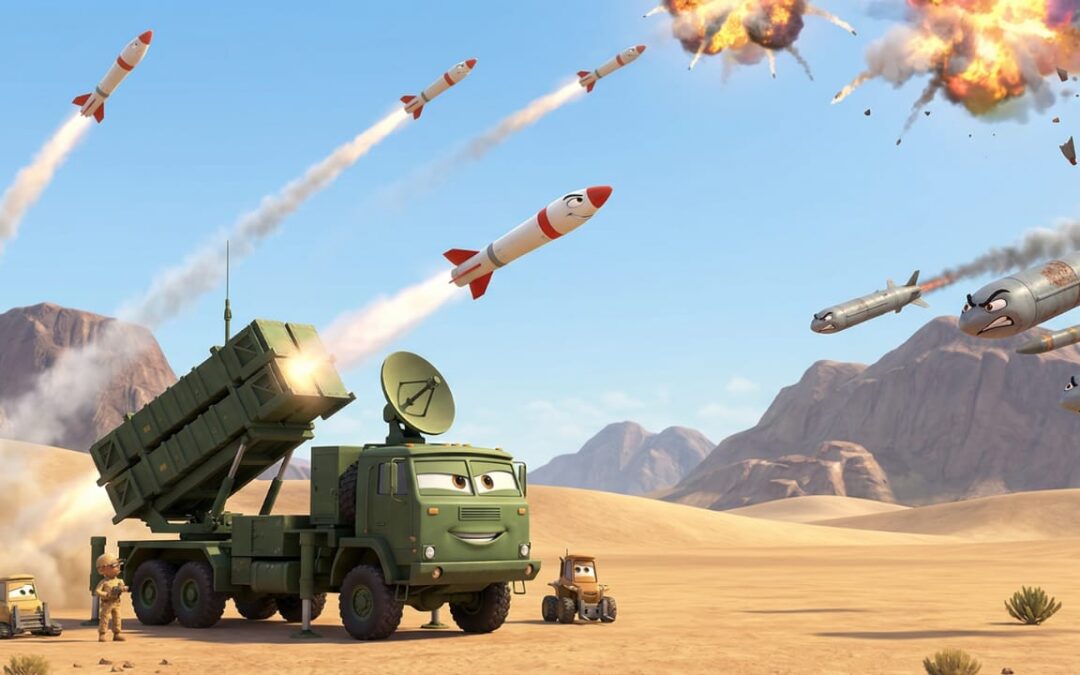
Patriot interceptors — 943 rounds fired across US and Gulf forces. 18 months of production consumed in four days. Gulf partners fired roughly twice as many as U.S. forces.
Israel’s Arrow interceptors — Over half the inventory gone in four days. Eight days remaining at that burn rate. 32 months to replace.
Watch & Listen
Stories from the Cockpit & Beyond

Command of the Reload.
For three decades, American grand strategy rested on what scholar Barry Posen called “Command of the Commons,” an unrivaled ability to project power anywhere on earth. Behind the Front introduces: Command of the Reload. The decisive factor in modern high-end conflict is no longer just the ability to strike, it is the industrial capacity to keep striking and keep defending after the opening magazines run dry.
The Iran war is the first real stress test of that capacity. And the results are uncomfortable.

Congress can appropriate $16 billion overnight. It cannot appropriate gallium, neodymium, or ammonium perchlorate into existence. Replacing the 5,197 munitions fired in the opening days requires approximately 92 tons of copper, 137 kilograms of neodymium, 18 kilograms of gallium, 37 kilograms of tantalum, 7 kilograms of dysprosium, and 600 tons of ammonium perchlorate.
China controls 98 percent of global gallium production, 90 percent of neodymium processing, and 99 percent of dysprosium, all critical for seeker heads, guidance systems, and radar modules. China banned gallium exports to the US in December 2024. We are fighting a high-tech war with a supply chain that runs through Beijing.

Protect your accounts and with Proton Pass –
the encrypted password manager from the team behind Proton Mail. Try it free at proton.me/afterburndefense
Hot take…not even that hot
The problem set is clearly larger than a stroke of the pen when it comes to writing a check to replenish the stockpile. Raw materials account for roughly 3 percent of the unit cost of a finished munition. A $4.5 million Patriot interceptor contains $5,000 to $15,000 in minerals. The money isn’t the problem. Availability is.
Former Navy Secretary Carlos Del Toro testified that replacing $1 billion in Red Sea munitions required over $2 billion to procure. Apply that ratio to a $16 billion bill and you’re looking at $32 billion to reload, if the materials are even available to buy.
Now we know the Pentagon’s own number. The Washington Post first reported, and Secretary Hegseth confirmed at a March 19th press briefing, that the Pentagon has sent a $200 billion supplemental funding request to the White House. The stated purpose: pay for what’s been spent, refill the magazines, and build stockpiles above and beyond pre-war levels. Hegseth’s exact words: “not just refilled, but above and beyond.”
That number is more than the entire annual defense budget of every country on Earth except the United States.
The industrial base, from the availability of raw materials to production capacity, plays a pivotal role. A strong industrial base is pivotal to maintaining military superiority and power projection
Support the Afterburn Podcast
Unlock exclusive There I Was… stories & ad-free interviews
Watch & Listen
Stories from the Cockpit & Beyond
