
Edited by Sidney McAlear
The What
For the past two months, we’ve taken you inside the Ogden Air Logistics Complex at Hill Air Force Base, Utah. Roughly 6,900 people work there, about 96 percent of them civilians, and they sustain nearly every aircraft in the Air Force inventory, plus the Minuteman III. The commander, Brigadier General Hall Sebren, gave us a behind-the-scenes look at how the Ogden Air Logistics Complex keeps the Air Force (and Navy) in the air. Watch Part V here.
Where did the checklist come to be? Check out our history section below.
In This Episode
Brigadier General Sebren highlighted a key issue: the smallest part, sometimes a single gear, often presents the greatest challenge. His own rough estimate: about 85 percent of the time the depot can’t produce something, it’s because it’s waiting on one small part. Not an engine. Not a wing. A part.
His example: the T-38 gearbox. Hill can rebuild more gearboxes than the Air Force can use, except for one gear nobody makes anymore. The machine that made it died years ago, the supplier went out of business, and now the depot strips worn gearboxes out of storage just to harvest the gears inside. The fix often requires creating it from scratch or diving into the vast and lengthy process of finding a new vendor…which is not a guarantee.
He also highlighted a great pain point that even I can understand as a pilot. For nearly every aircraft the Air Force buys, it skips buying the tech data up front to save money. Meaning if we need to re-engineer a part three decades from now…we don’t have the blueprints to do so.
Sustainment (the part that actually costs the most) can run upwards of 70 percent of a weapon system’s lifetime cost, and Brigadier General Sebren says if you don’t buy the data early, you’ll pay two, three, or four times more for it later.
We love talking about new jets. But a fleet is only as ready as its least available part. If you can’t fix it, do you really own it?
Basically a new F-16.
A few years ago, an F-16 came to Hill for a quick mod or a paint job. Now it comes in for the Service Life Extension Program and leaves with a rebuilt structure, an AESA (active electronically scanned array) radar, and a high-speed data network. Brigadier General Sebren joked that the Air Force should probably change the letter at the end of “F-16” because it’s almost an entirely new jet. We showed the structural side of that in Part II, where crews rebuild the beam that holds the wing on at 9 Gs. The same shift changed who the depot needs: fewer electricians, more structural mechanics.
The fight over the data.
Brigadier General Sebren says there’s real disagreement right now over which tech data rights the Air Force thinks it already bought versus what it actually has. Ownership changes speed. Once the Air Force bought the rights to the F-16’s flight software, the software engineering group at Hill could push updates much faster than when every change had to go back through the manufacturer. I saw this with my own eyes: software updates that once took two to three years started coming almost overnight. (Turns out the Guard F-16s were way ahead in this arena.)
The other side: Buying full data rights up front is expensive; contractors protect it as their intellectual property, and every dollar spent on data in year one isn’t spent on jets. Nobody knows in 2026 exactly which parts will become orphans in 2046.
What’s coming.
The next airframe is already on the way. In May, Hill broke ground on its East Campus — five facilities planned by 2032 including a T-7A depot complex and new F-35 shops. It will be the only place the T-7 gets depot-level maintenance.
Bottom line: New jets get the headlines. Depots, piece parts, and data rights decide how many of them actually fly.
Want the full sit-down? Here’s Part V.
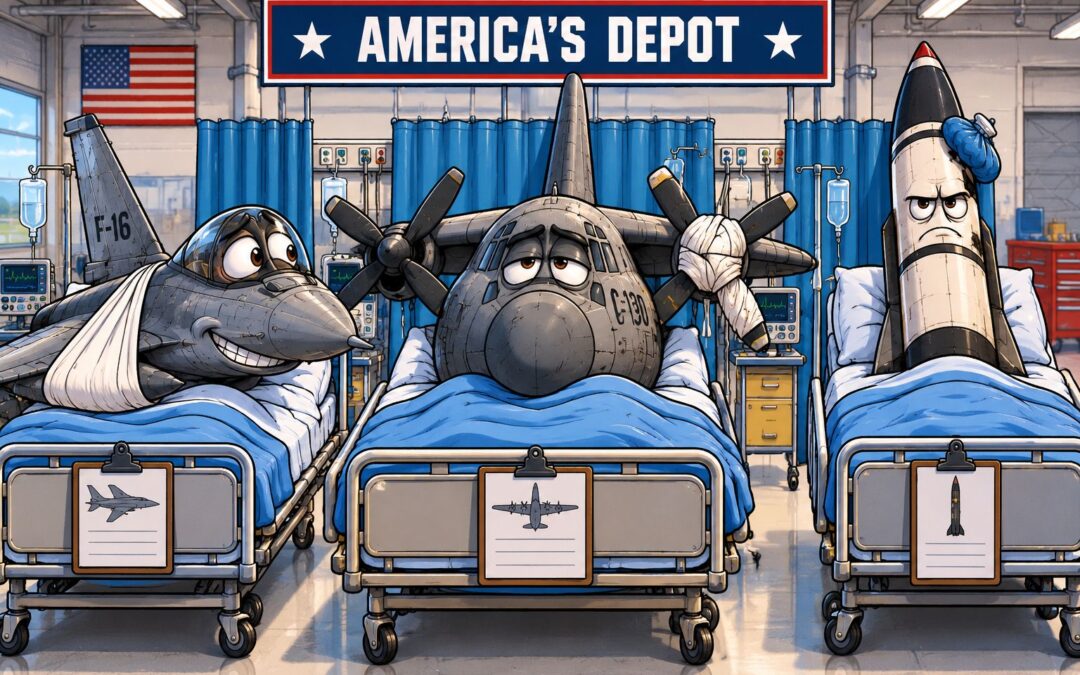
Catch the full America’s Depot series:
-
Part I: How the U.S. Rebuilds a $100 Million Fighter Jet: Stripping F-16s to bare metal, the landing gear shop, and F-35 heavy maintenance.
-
Part II: Replacing the Beam That Holds the Wing at 9 Gs: Lasers, a ten-thousandth of an inch, and why one jet flew crooked.
-
Part III: Behind the Scenes of Aircraft Battle Damage Repair: I take an axe to an A-10 and an F-16, on purpose.
-
Part IV: Inside the Only Place That Can Take an F-16 Completely Apart: Wings off, gun out, and the flight test team that signs the jet back out.
-
Part V: How the Air Force Keeps Fighter Jets Flying for 40 Years: The leadership interview.
Watch & Listen
Stories from the Cockpit & Beyond

Additional Pile-Ons
-
The T-7 hangar is real now. On September 30, Mortenson won a $218.7 million contract to build Hill’s T-7A depot hangar — about 302,000 square feet with 16 maintenance docks, sized for a 250-person crew supporting a planned 351-jet fleet.
-
The last Hawg out. The final A-10 to go through Hill’s depot, tail 78-0655, left in February. The 571st Aircraft Maintenance Squadron deactivated after doing A-10 depot work since 1998.
-
The B-1 that Sebren mentioned. That’s tail 86-0115, formerly “Rage.” It was pulled out of the boneyard in July 2024, spent almost two years being regenerated at Tinker, and is flying again out of Dyess as “Apocalypse II.”
Threat of the Day
Bayraktar TB2
Country of Origin: Turkey
IOC: 2014
Primary Role: Armed medium-altitude, long-endurance drone
Proliferation: Export deals with more than 30 countries, including Ukraine, Azerbaijan, Poland, and Qatar
The TB2 became famous over Nagorno-Karabakh in 2020 and in the opening weeks of the war in Ukraine, showing how a relatively cheap armed drone can punish armor and air defenses. Fittingly for this issue: Baykar says the first TB2 to enter service was retired after reaching its 10,000-hour airframe life.
Support the Afterburn Podcast
Unlock exclusive There I Was… stories & ad-free interviews
In History
On October 30, 1935, Major Ployer “Pete” Hill was at the controls of Boeing’s Model 299, the prototype of the B-17 Flying Fortress, at Wright Field, Ohio. The crew had left the control locks engaged, and the bomber crashed on takeoff, killing Hill and Boeing test pilot Leslie Tower. Boeing’s answer was the pilot checklist, now in every cockpit in the world. In 1939, the Ogden Air Depot was renamed Hill Field in his honor, and it became Hill Air Force Base in 1948. Air & Space Forces Magazine tells his full story here. Ninety-one years later, the depot that carries his name is still keeping the fleet flying, one checklist at a time.