
Edited by Sidney McAlear
The What
On September 29, 2026, the Navy picked Boeing over Northrop Grumman to build its next carrier fighter, the F/A-XX, with a full-scale development contract worth more than $20 billion that covers multiple test aircraft….not production.
The jet is expected to fly in the 2030s and replace the Super Hornet (F/A-18E/F) and Growler (E/A-18G). Boeing already builds the Air Force’s F-47, which it won in March 2025, with a first flight targeted for 2028. That makes Boeing the sole prime on both of America’s crewed sixth-generation fighters, a year after the Pentagon tried to shelve this exact jet because industry could only go fast on one at a time. I broke it all down in this week’s video.
Warm Take
I’m not a carrier guy. I like my 10,000 foot runways, but here we are. Dos Gringos captures my feelings best with I want to Takeoff from a Carrier…not for sensitive ears.
Boeing’s pitch makes sense considering they know how to build a jet that is capable of slamming into a carrier deck, at speed (no crosswind of course), no flare, over and over again. Lockheed does get “street cred” with the F-35C.
Boeing doesn’t have to re-invent the wheel but can “simply” apply lessons learned from their years of experience building carrier-based platforms. Plus, they now have a year of work into the F-47.
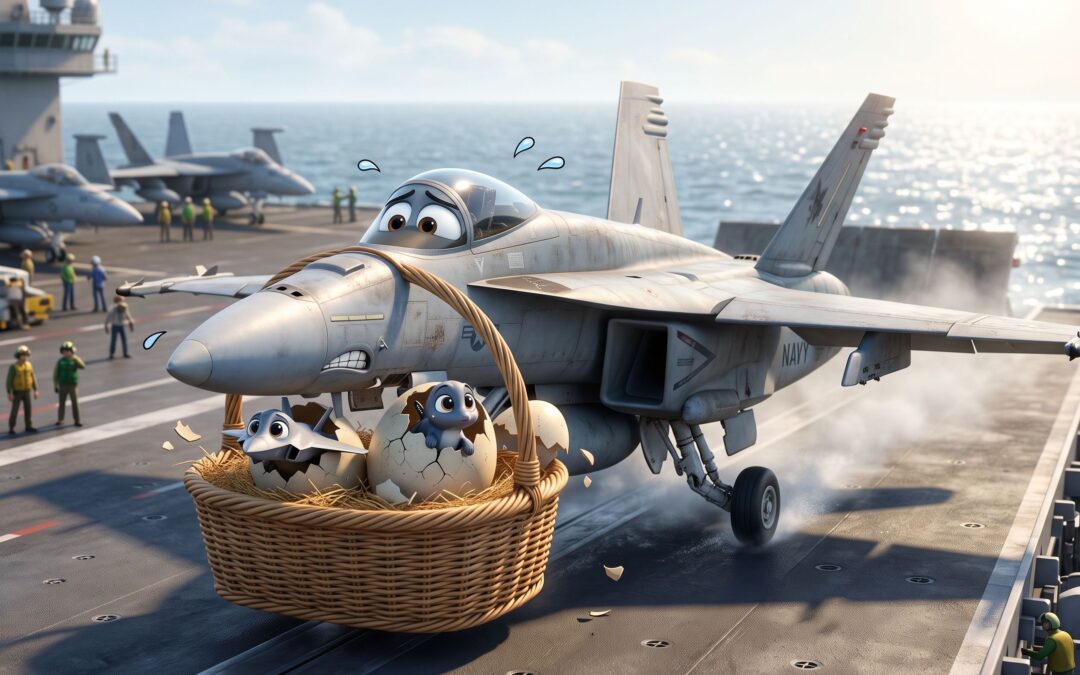
But now we have all our eggs in one basket.
The KC-46 is a 767 with a boom. The tanker replacement saga started in the early 2000s, and the jet still isn’t where it should be. While I acknowledge there is more depth to that saga, it still isn’t a great report card. T-7 behind schedule. VC-25B behind schedule. 737 Max. Door plugs. Starliner Spacecraft delays. It has been a rough few innings. But to be fair, the F-15EX and Super Hornet have gone fairly smooth.
The F-47 is supposed to fly in 2028. F/A-XX in the 2030s. If history tells us anything, how often does that happen?
An additional thought. We’re building exquisite, decade-long programs while the threat keeps moving. Nobody planned for cheap drones to reshape the battlefield, and they did. Whatever we build has to adapt to the fight we can’t see yet.
The F-47 marks a departure from traditional aircraft acquisition. Now, there is a requirement for open architecture — government ownership of intellectual property — and standardization of interfaces to allow easy entry of competitors. These updates will allow the Air Force to “rapidly” adjust to evolving threats and needs.
Peeling Back the Onion
On ice, then back on.
This jet almost didn’t happen.
The timeline:
-
Early 2025: Congress gave F/A-XX $454 million in the full-year continuing resolution, expecting the Navy to award a single-company development contract that March.
-
March 21, 2025: Boeing won the F-47 over Lockheed Martin, which had already been knocked out of F/A-XX. That left Boeing and Northrop. The Navy didn’t name a winner.
-
June 2025: The Pentagon asked for “just” $74 million for F/A-XX — 84 percent less than the year before — while asking nearly $3.5 billion for the F-47. A senior defense official told Mikayla Easley at DefenseScoop that the department had decided to go “all-in on F-47.”
-
July 2025: The White House formally warned Congress that awarding F/A-XX would likely delay the higher-priority F-47.
-
January 2026: Congress overruled it. The final 2026 spending bill gave F/A-XX $972 million, restricted to awarding a development contract to one company, and scolded the Pentagon for spending nearly all of the 2025 money on contract extensions.
-
August 2026: The Navy missed its own deadline. The award finally came September 29.
Same jet, different deck?
The F-47 is the Air Force’s F-22 successor. The plan is at least 185 jets (remember our F-22 procurement plan from our last newsletter?), and a pre-production example is being built now. Joseph Trevithick at The War Zone reports that Brigadier General Timothy Helfrich says it’ll be much more survivable than today’s fifth-generation jets, with a combat radius of more than 1,000 nautical miles (1,852 km). He also pointed out the U.S. has only three active fighter production lines.
The Navy’s jet is supposed to be different. In 2024, the Navy said it would develop its fighter independently, with a derivative engine and a multirole strike mission instead of the Air Force’s air-superiority focus. Stefano D’Urso at The Aviationist notes that the Navy has talked about roughly 25 percent more range than the F-35C, more advanced jamming than the Growler, and a jet built from the start to quarterback Collaborative Combat Aircraft (CCA) drones.
But according to Reuters, as reported by Alison Bath at Stars and Stripes, Boeing pitched a carrier version of its F-47 design, while Northrop offered a clean-sheet jet. Boeing’s Super Hornet history also helped answer the Pentagon’s questions about engineers and suppliers. Nobody official has said how much the two jets will actually share.
The case against.
Boeing says it was ready. Its defense chief, Steve Parker, said “[d]elivering two advanced fighters in parallel was always [the] plan.” Not everyone is convinced. Two weeks before the award, General Dale White, the Air Force’s top acquisition advisor, said he still had industrial capacity concerns, though not unique to these two programs.
Then there’s the contract itself. The Navy hasn’t said what kind it is. Fixed-price development deals have burned Boeing before, and analysts are watching for it.
And it isn’t over. Northrop has said it’s waiting for details on why it lost, and it could still protest. A protest would put the work on hold while the Government Accountability Office (GAO) reviews it.
Bottom line: The capacity worry didn’t go away. The Pentagon just picked a winner. Now Boeing has to prove one company can run two sixth-generation programs at once…without either one slipping.
Want the full breakdown with visuals? Here’s this week’s video.
Watch & Listen
Stories from the Cockpit & Beyond


Additional Pile-Ons
-
The Hornet’s last contract. The same day Boeing won F/A-XX, the Navy gave it a separate contract worth about $16.7 million to support the final shutdown of the Super Hornet and Growler production line.
-
Its long stick. The Navy said in August that F/A-XX is expected to carry Raytheon’s AIM-424 long-range air-to-air missile.
-
The Hornet has Northrop DNA. The original F/A-18 Hornet grew out of Northrop’s YF-17, which lost the Air Force fly-off to the F-16 before McDonnell Douglas reworked it for the Navy. Boeing inherited the Hornet line in the 1997 merger. So the company that just lost F/A-XX helped design the jet it’s replacing.
Threat of the Day
3M22 Zircon (NATO: SS-N-33)
Country of Origin: Russia
IOC: 2023
Primary Role: Hypersonic anti-ship cruise missile with a land-attack role
Proliferation: Russia only
Russia claims Mach 9 and a range of about 540 nautical miles (1,000 km), though neither is independently verified. It entered service in January 2023 aboard the frigate Admiral Gorshkov. Threats like this push carriers farther offshore, which is exactly why the Navy wants more range out of F/A-XX.
Support the Afterburn Podcast
Unlock exclusive There I Was… stories & ad-free interviews
In History
On January 7, 1991, Defense Secretary Dick Cheney canceled the Navy’s A-12 Avenger II, a stealthy carrier-based flying-wing attack jet from McDonnell Douglas and General Dynamics. It was behind schedule and over budget, and Cheney said nobody could tell him what it would cost or when it would be ready. The legal fight over the cancellation dragged on until 2014. McDonnell Douglas became part of Boeing in 1997. Thirty-five years later, Boeing is building the Navy’s next stealthy carrier jet. Here’s hoping the sequel goes better.